
How to calculate the benefit in kind for an electric company car?


.svg)
Electric cars are becoming increasingly popular. This is due partly to their ever-improving driving range and partly to the favourable tax treatment of electric company cars. When private use of a company car is allowed, the Belgian tax authorities consider this a benefit in kind (BIK). This benefit is taxed in the personal income tax of the user (employee or company director).The tax rules for fully electric company cars remain more advantageous than those for vehicles with combustion engines.
What will change in 2026?
1. Electric cars remain tax-efficient
For electric vehicles, the BIK is calculated based on the catalogue value, without taking CO2 reference values into account (as EVs produce no CO2 emissions).
A minimum BIK rate of 4% of the catalogue value always applies.
Simplified formula for EVs in 2026:
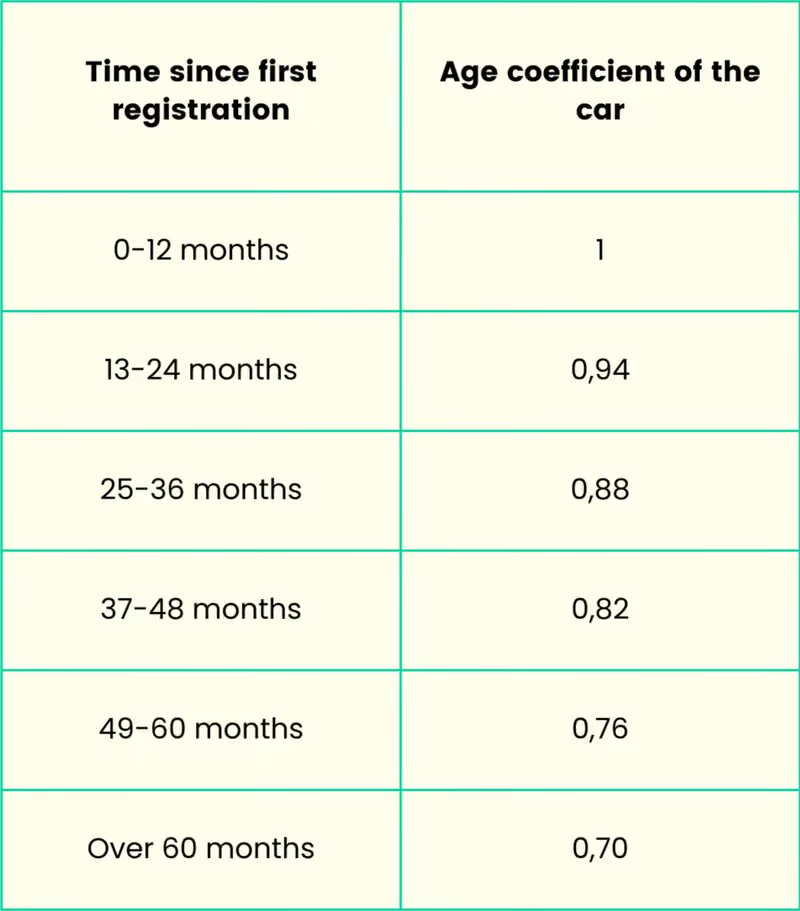
Benefit in kind = Catalogue value × 4% × (6/7) × age coefficient
- The catalogue value includes all options and accessories, VAT and BPM included, without discounts.
- The 6/7 factor represents the portion deemed to relate to private use.
- The age coefficient reduces the BIK as the vehicle gets older.
Example: an electric company car with a catalogue value of €55,000 results in a BIK of approximately: €55,000 × 4% × 6/7 = €1,886 per year, before applying the age coefficient.
2. Minimum BIK amount in 2026
No official minimum BIK amount has yet been published for 2026. However, based on forecasts and indexation, it is expected to be around €1,690 per year. If the calculated BIK is lower than this amount, the minimum amount will apply.
3. CO2 reference values, not applicable to EVs
New CO₂ reference emission values have been published for 2026 for vehicles with combustion engines:
- 58 g/km for diesel vehicles
- 70 g/km for petrol, LPG, or natural gas vehicles
These lower reference values lead to higher BIK amounts for combustion vehicles. Electric vehicles are excluded from this mechanism and continue to benefit from the fixed 4% rate.
Tax deductibility and other benefits in 2026
1. Deductibility
Electric company cars purchased or leased in 2026 remain 100% tax deductible for companies and self-employed individuals.
From 2027 onwards, this deductibility will be gradually reduced, for example:
- 95% in 2027
- 90% in 2028
- and so on.
2. Other benefits
- Brussels: the vehicle registration tax (BIV) for electric cars remains very low at €74.29.
- Wallonia: a minimum BIV rate also applies (approximately €61.50).
- Flanders: the full exemption for purely electric vehicles was abolished as of 1 January 2026.
Tax benefits for hybrid cars?
Hybrid vehicles are losing their appeal from a tax perspective. Many fall into the category of “false hybrids” if they:
- emit more than 50 g of CO2, or
- have an electric battery capacity of less than 0.5 kWh per 100 kg of vehicle weight.
In such cases, the benefit in kind is significantly less attractive than for fully electric cars. False hybrids are treated as petrol vehicles and are subject to the following formula: List price × [5.5 + ((CO2 – 91) × 0.1)]% × 6/7 × age coefficient.
A “true” hybrid, on the other hand, follows the same BIK formula as an electric vehicle.
Phasing out deductibility for hybrid cars
The tax deductibility of hybrid vehicles is being phased out for both individuals and companies.
- For companies, deductibility has been reduced by 25% per year since 2025.
- From tax year 2026, this means that vehicles purchased are only 50% deductible.
- This reduction also applies to fuel costs for full and mild hybrids.
- Electricity costs remain 100% deductible, but this deduction will be fully abolished from tax year 2028 onwards.
The CO2 contribution (also known as the solidarity contribution) is also increasing significantly, from an average of €50 per month in 2023 to €275 per month in 2026. Most tax advantages for hybrid vehicles disappeared on 1 July 2023. Hybrid cars ordered after 1 January 2026 will lose all tax deductibility.
Future outlook for benefit in kind
Full tax deductibility for electric cars ordered before 1 January 2027 is guaranteed until 2032. Vehicles ordered after that date will see their deductibility gradually reduced, but not completely eliminated, unlike hybrid vehicles.
Want to simplify the management of your company mobility?
👉 Discover Mbrella or speak to our experts.