
Electric fleets, rising charging costs and flexible mobility: is it time for a mobility reset?

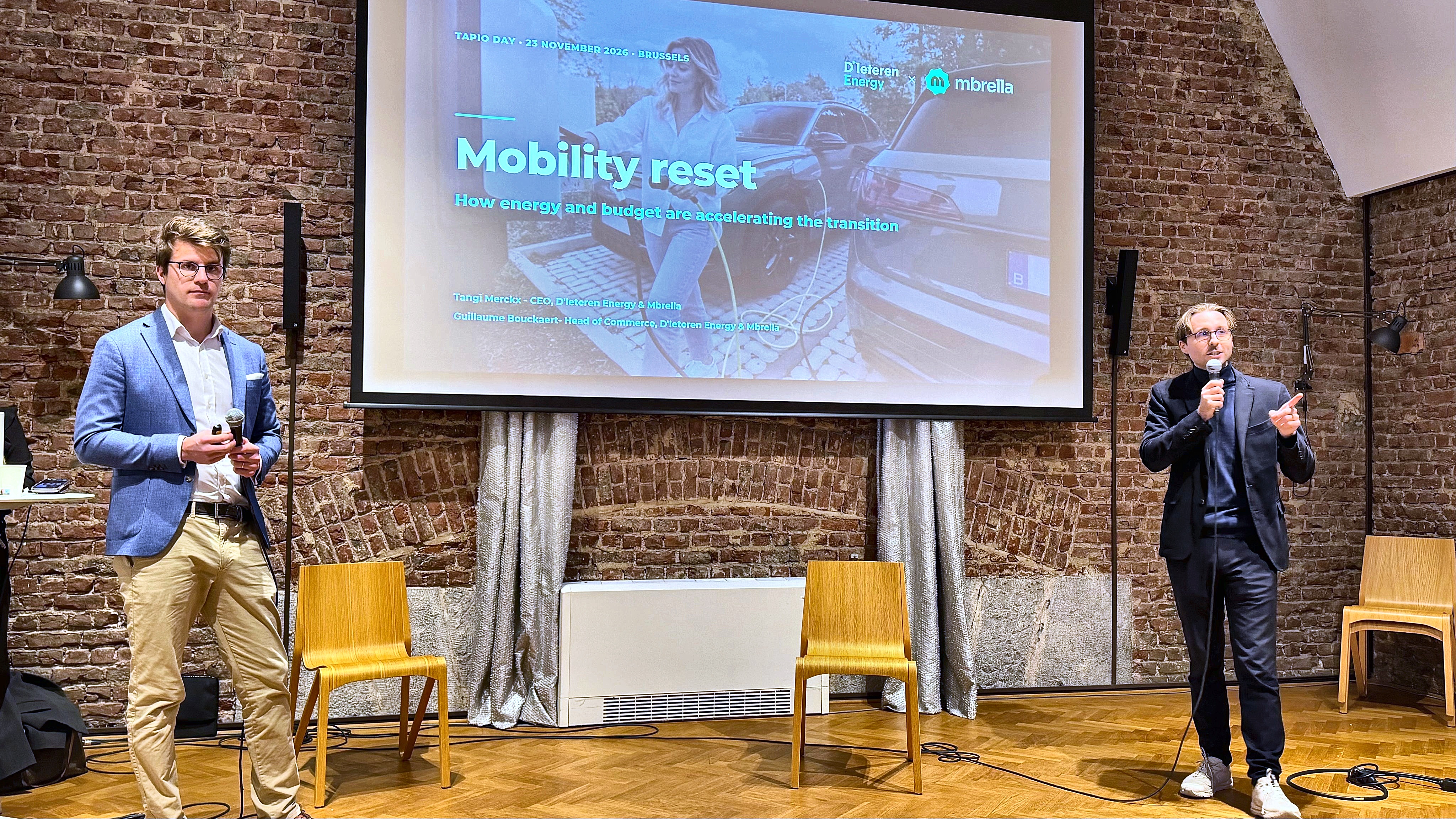

Over the past few years, many Belgian companies have focused on electrifying their fleets. Now that more employees are driving electric, managing charging costs is becoming an increasingly important part of fleet management. At the same time, not every employee wants or needs a company car.
At Tapio Day, Tangi Merckx (CEO Mbrella and D'ieteren Energy) and Guillaume Bouckaert (Head of Commerce) shared insights from Mbrella and D’Ieteren Energy on these developments and what they mean for employers.
How is corporate mobility evolving in Belgium?
Despite the growing popularity of cycling and alternative mobility options, 62% of Belgian commuters still travel to work by car, compared to 67% in 2005.
In September 2026, fully electric vehicles accounted for 50.9% of new car registrations in Belgium, reaching a historic milestone.
With tax deductibility for newly acquired electric company cars dropping from 100% to 95% in January 2027, companies planning to renew their fleets may want to do so before the end of the year.
Where does your EV charging budget go?
Charging data from several large companies shows that even when employees have access to charging facilities at home and at work, approximately half of their charging still takes place in public.
This is particularly interesting given the difference in cost:

For a fleet of 100 vehicles consuming 2,500 kWh each annually, shifting half of their public charging to home charging could save around €16,250 per year.
Why aren't employees charging more at home?
There are two main reasons why employees tend to avoid home charging.
- The first is home charging reimbursement. Employees sometimes feel that the CREG reference rate doesn't cover what they actually pay for electricity. As the rate is based on average market prices rather than individual energy contracts, this can indeed be the case.
- The second is the capacity tariff in Flanders. Many employees are concerned that charging their electric car at home will significantly increase their electricity bill.
One practical solution is to limit home charging power to around 4 kW. For most employees who charge overnight, this is more than enough to cover their daily driving needs.
The hidden costs of public EV charging
Prices at public charging stations can vary considerably. Two chargers on the same street might charge €0.27 and €0.65 per kWh respectively. There are also additional fees to consider, particularly when a car remains connected after charging.
During the session, the speakers shared an example of an employee who left their electric car connected to a charging station while on holiday for several weeks. The resulting bill was €36,000.
Although exceptional, the speakers reported finding individual charging sessions exceeding €1,000 at every company they had analysed.
In the €36,000 case, the employee hadn't actually broken any rules. The company simply didn't have a charging policy in place.
How can employers reduce EV charging costs?
Restricting public charging altogether isn't necessarily the answer. Employees who spend most of their day on the road have different needs from those who work primarily at the office.
Companies can better manage charging expenses by introducing a few measures:
- Set a maximum accepted price per kWh.
- Introduce monthly charging budgets based on driving profiles.
- Define when fast charging is necessary.
- Use geofencing to manage charging abroad.
- Encourage home and workplace charging.
- Monitor unusually expensive charging sessions.
It's also worth reviewing workplace charging infrastructure. Installing more charging points at lower power could be more practical than installing fewer high-powered chargers, especially when employees typically spend the entire day at the office.
Beyond the electric fleet: the Belgian mobility budget
NThe Belgian federal mobility budget allows eligible employees to spend their company car budget across three pillars:
- Pillar 1: A zero-emission company car.
- Pillar 2: Sustainable mobility options and eligible housing costs.
- Pillar 3: A cash payout of the remaining budget, subject to a special social security contribution.

An employee could choose a smaller electric car and use the remaining budget for bike leasing or public transport. Someone living close to the office might prefer to give up their car entirely and use their budget towards eligible housing costs.
Both options can coexist within the same company.
What should companies focus on in 2027?
Four recommendations emerged from the session:
- Review upcoming fleet orders before the tax changes in January 2027.
- Encourage home and workplace charging wherever possible.
- Introduce clear guidelines for public charging.
- Give employees more flexibility through the mobility budget.
Before making changes to their mobility policy, companies should look at how employees travel, where they charge and what these choices actually cost. Often, there are opportunities to reduce expenses without taking away employee benefits.
Looking to optimise your fleet, reduce charging costs or introduce the federal mobility budget? Get in touch with Mbrella and D’Ieteren Energy.